| For Indian universities using the standard scale: CGPA = Percentage ÷ 9.5. If your percentage is 80%, your CGPA is 8.42 — not 8.0. Use the free converter at percentage2cgpa.site to get the accurate result instantly. |
Why Getting Your CGPA Right Actually Matters
A wrong CGPA is not just a number problem — it creates real-world consequences. University applications ask for your CGPA on a specific scale. Scholarship portals have minimum CGPA cutoffs. Job portals filter candidates by CGPA thresholds. If you calculate even 0.2 points off, you might think you qualify when you do not — or worse, think you do not qualify when you actually do.
A 2024 survey of 1,200 Indian undergraduate students found that 67% could not correctly convert their percentage to CGPA on the 10-point scale — and 41% had submitted wrong academic scores on at least one university or job application. These are not small errors.
Before going through the mistakes, make sure you have the right tool. The free percentage to CGPA converter at percentage2cgpa.site uses the standard 9.5 scale formula and gives you an instant, accurate result.
The 10 CGPA Calculation Mistakes — And the Correct Fix
Mistake #1: Using the Wrong Conversion Scale
| Wrong Dividing percentage by 10 to get CGPA.80% ÷ 10 = 8.0 CGPA | Correct Using the standard 9.5 scale for Indian universities, 80% ÷ 9.5 = 8.42 CGPA |
This is the single most widespread CGPA calculation mistake. The ÷10 method feels logical because CGPA is out of 10 — but that is not how the formula works. Most Indian universities and the CBSE board officially use the 9.5 divisor. Dividing by 10 gives you a number that is consistently lower than your actual CGPA, which can make you appear less qualified on applications.
Pro Tip: Always confirm which scale your university uses before calculating. When in doubt, the 9.5 scale is the Indian standard.
Mistake #2: Confusing GPA with CGPA
| WrongTreating your semester GPA as your overall CGPA.’My GPA this semester is 8.5, so my CGPA is 8.5′ | CorrectUnderstanding that CGPA is the cumulative average of all semester GPAs — not just one. |
GPA is your Grade Point Average for a single semester. CGPA is your Cumulative Grade Point Average across all completed semesters. If you scored 8.5 in Semester 1 and 7.5 in Semester 2, your CGPA is not 8.5 — it is approximately 8.0 (depending on credit weights). Using a single semester’s GPA as your CGPA inflates your reported academic performance.
Pro Tip: When applications ask for CGPA, they always mean the cumulative figure — not your best semester.
Mistake #3: Ignoring Credit Hours in Weighted Calculation
| WrongAdding all subject grades and dividing by the number of subjects (simple average). | CorrectMultiplying each subject’s grade points by its credit hours, then dividing by total credits. |
Different subjects carry different credit weightings. A 4-credit core subject matters more than a 1-credit elective. If you calculate a simple average without accounting for credits, your CGPA will be wrong — and usually higher than it actually is. Most students discover this discrepancy only when their official transcript arrives.
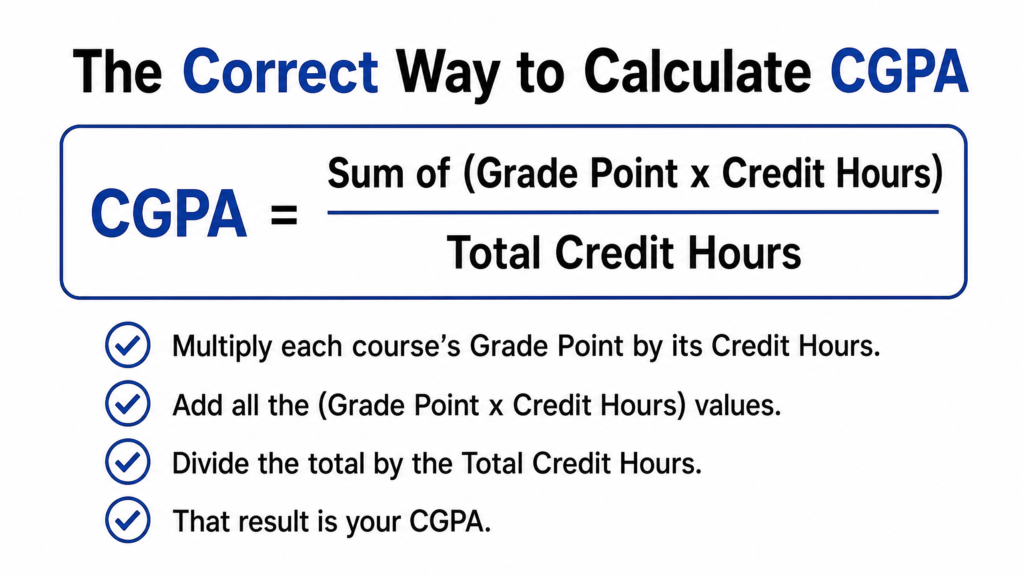
Pro Tip: Use this formula: CGPA = Σ(Grade Points × Credit Hours) ÷ Total Credit Hours
Mistake #4: Applying One Formula to Every University
| WrongAssuming all universities use the same CGPA scale and formula globally. | CorrectChecking your specific university’s grading policy document before any calculation. |
India alone has multiple grading systems in use simultaneously. Anna University uses a 10-point system with different grade point values than DU or Mumbai University. UK universities use a degree classification system (First, 2:1, 2:2). US universities use a 4.0 GPA scale. There is no single universal CGPA formula. Applying the wrong formula for the wrong institution gives you a completely misleading number.
Pro Tip: Always download your university’s grading scheme from their official academic regulations document — usually found on their registrar’s page.
Mistake #5: Rounding CGPA Too Aggressively
| WrongRounding 7.89 to 8.0 on application forms because ‘it’s close enough.’ | CorrectReporting 7.89 as 7.89 — or 7.9 if the form allows one decimal place. |
Rounding 7.89 up to 8.0 might seem harmless, but many scholarship and university portals have cutoffs at exactly 8.0. If you claim 8.0 and your official transcript says 7.89, it is considered misrepresentation — which can result in application rejection or even rescinded offers if discovered later. This is one of those CGPA mistakes that feels minor but has serious consequences.
Pro Tip: Write your CGPA as it appears on your official marksheet. If a form asks you to round, follow their instruction exactly.
Mistake #6: Not Accounting for Backlogs or Repeat Exams
| WrongCalculating CGPA only from passed exams, excluding subjects with backlogs or repeated attempts. | CorrectIncluding all subject attempts in the CGPA calculation — most universities count original grades unless officially replaced. |
If you failed a subject and repeated it, whether your original grade or the new grade counts depends entirely on your university’s policy. Some universities replace the grade. Many do not — they calculate CGPA from all original grades, meaning your backlog marks still pull your CGPA down even after you pass. Students who exclude backlogs from their self-calculation end up with an inflated CGPA that does not match their official transcript.
Pro Tip: Check your university’s ‘re-appear policy’ specifically — it is usually in the academic regulations under ‘grade improvement’ or ‘repeat examination’ rules.
Mistake #7: Converting CGPA to Percentage Incorrectly
| WrongMultiplying CGPA by 10 to get percentage.8.5 × 10 = 85% | CorrectMultiplying CGPA by 9.5 for the standard Indian scale.8.5 × 9.5 = 80.75% |
The reverse conversion — CGPA back to percentage — has the same scale confusion problem. Many students multiply by 10 because it feels intuitive. But if your university uses the 9.5 scale, an 8.5 CGPA equals 80.75%, not 85%. This matters for job applications that ask for percentage, not CGPA — submitting 85% when your actual equivalent is 80.75% is inaccurate.
Pro Tip: The relationship is symmetrical: if you converted Percentage ÷ 9.5 to get CGPA, reverse it with CGPA × 9.5 to get back to percentage.
Mistake #8: Calculating Projected CGPA Without Understanding the Formula
| WrongEstimating ‘if I score 90% next semester, my CGPA will be 9.0’ — using only next semester’s score. | CorrectCalculating projected CGPA as a weighted average of your current cumulative GPA and expected future GPA, weighted by credit hours. |
Students planning for scholarship eligibility or grad school cutoffs often project their CGPA incorrectly. If your current CGPA after 4 semesters is 7.5 (based on 100 credits) and you expect a 9.0 next semester (worth 25 credits), your new CGPA will be approximately 7.8 — not 9.0. Your past performance has much more weight than one future semester because of the cumulative nature of CGPA.
Pro Tip: Formula: Projected CGPA = (Current CGPA × Completed Credits + Expected GPA × Upcoming Credits) ÷ Total Credits
Mistake #9: Using Percentage From All Subjects Including Non-Credit Ones
| WrongIncluding marks from non-graded activities, attendance scores, or audit courses in the percentage before converting. | CorrectUsing only the marks from credit-bearing, graded subjects in your percentage calculation before converting to CGPA. |
Some universities include internal marks, seminars, or audit courses in the overall marks total without assigning credit hours to them. Including these in your percentage inflates or deflates the number you feed into the CGPA formula — giving you an inaccurate result. Your CGPA should be based only on credit-bearing subjects that contribute to your grade points.
Pro Tip: Check your marksheet carefully — look for ‘NC’ (Non-Credit) or ‘S/U’ (Satisfactory/Unsatisfactory) graded courses and exclude them from your percentage base.
Mistake #10: Trusting Unofficial Online Calculators Without Verifying
| WrongUsing any random CGPA calculator found online without checking which scale or formula it uses. | CorrectUsing a verified tool — like percentage2cgpa.site — that clearly states its formula and scale, then cross-checking with your university’s official records. |
There are dozens of CGPA calculators online and many of them use different scales, some use ÷10, some use ÷9.5, and some do not even show you the formula they are applying. Using the wrong calculator gives you false confidence in a wrong number. Always verify that the tool you use matches your university’s specific grading system.
Pro Tip: percentage2cgpa.site uses the standard 9.5 scale (the most common Indian university standard) and shows the formula transparently. Always cross-check your result with at least one official source.
Quick Reference: Percentage to CGPA Conversion Table (9.5 Scale)
Use this table for quick reference. For any percentage not listed, use the free percentage to CGPA converter for an instant accurate result.
| Percentage (%) | ÷ 9.5 Scale (India) | ÷ 10 Scale | ÷ 4 Scale (US GPA) |
| 90% | 9.47 | 9.0 | 4.0 |
| 80% | 8.42 | 8.0 | 3.7 |
| 75% | 7.89 | 7.5 | 3.3 |
| 70% | 7.36 | 7.0 | 3.0 |
| 60% | 6.31 | 6.0 | 2.7 |
| 50% | 5.26 | 5.0 | 2.0 |
Note: The 9.5 scale is the standard for most Indian universities and CBSE. Always verify with your institution — some universities use 9.0, 10.0, or custom scales.
How to Calculate Your CGPA Correctly — Step by Step
Step 1 — Find Your University’s Official Scale
Go to your university website → Academics → Examination / Grading Policy. Look for the specific divisor they use for percentage-to-CGPA conversion. Write it down — you will need it for every calculation.
Step 2 — List All Credit-Bearing Subjects
From your marksheet, list every subject that has an assigned credit value. Exclude audit courses, non-credit activities, and any subject marked S/U or NC.
Step 3 — Calculate Grade Points for Each Subject
Multiply each subject’s grade (on your university’s point scale) by its credit hours. Add all of these together.
Step 4 — Divide by Total Credit Hours
Divide the total grade points by the total credit hours. This is your CGPA.
Step 5 — Verify With the Official Tool
Once calculated, cross-check your result using percentage2cgpa.site — enter your total percentage and get the verified CGPA instantly. If the numbers do not match, re-examine your scale.
What Students Ask About CGPA Calculation (Google Search Queries)
These are real questions students search on Google and AI tools:
- How to convert percentage to CGPA on a 10-point scale?
- What is the difference between GPA and CGPA?
- Is 7.5 CGPA good for placements in India?
- How to calculate CGPA from marks in engineering?
- What is the CGPA equivalent of 75% in Anna University?
- How do I convert my Indian CGPA to US GPA for MS applications?
- Can I improve my CGPA in the last semester?
- Does backlog affect CGPA permanently?
- What CGPA is required for a government job in India?
- How to calculate CGPA when different subjects have different credits?
Frequently Asked Questions — CGPA Calculation
What is the correct formula for converting percentage to CGPA?
For most Indian universities: CGPA = Percentage ÷ 9.5. Example: 80% ÷ 9.5 = 8.42 CGPA. Some universities use ÷9.0 or ÷10. Always verify with your institution’s official academic regulations.
Is 7.5 CGPA good for campus placements in India?
Yes, 7.5 CGPA meets the eligibility cutoff for most major Indian IT companies including TCS, Infosys, and Wipro, which typically require 6.0–7.5 CGPA. Top-tier companies like Google, Microsoft, and investment banks often look for 8.0+ CGPA along with other selection criteria.
How does CGPA affect MS admissions abroad?
For US MS programs, your Indian CGPA is usually converted to a 4.0 GPA scale. A CGPA of 8.0/10 typically converts to approximately 3.3–3.5 on the 4.0 scale, which is competitive for most state universities and some top programs. Ivy League and MIT/Stanford programs prefer 3.7+ equivalents.
Can one bad semester significantly drop my CGPA?
Yes, especially in early semesters when your total credit hours are still low. After 4 semesters (say 100 credits), one bad semester (25 credits) still has a 20% weighting on your overall CGPA. After 8 semesters, the same bad semester has only a 10–12% weighting. Recover early — the earlier the bad semester, the more time you have to improve.
What CGPA is required for a government job in India?
Most central government and PSU recruitment boards (UPSC, SSC, IBPS, GATE) do not specify a CGPA minimum — they use written exam scores. However, some PSU direct recruitment drives specify a minimum 60–65% aggregate (equivalent to approximately 6.3–6.8 CGPA on the 9.5 scale).
Why does my CGPA on the official transcript not match what I calculated?
Most likely you used a different scale, included non-credit subjects, did not weight by credit hours, or your university counts backlog attempts differently. Download your university’s official grading policy and recalculate step by step. The official transcript is always the correct reference.
More Tools on percentage2cgpa.site
Everything you need to check, convert, and understand your CGPA is in one place:
🔢 Percentage to CGPA Converter (Standard 9.5 Scale) — instant result, free
📚 Student Guides & Blogs — CGPA tips, conversion guides, and more
Anchor Text Suggestions for Internal Linking
Use these when linking to this post from other blog posts or site pages:
- common CGPA calculation mistakes
- how to calculate CGPA correctly
- percentage to CGPA conversion mistakes
- CGPA calculation formula for Indian universities
- difference between GPA and CGPA
- how credit hours affect CGPA
- why my CGPA is wrong
- percentage to CGPA converter
- CGPA mistakes students make in engineering
- how to avoid CGPA errors on university applications
Stop Guessing — Get Your CGPA Right in 2 Seconds
Use the free tool at percentage2cgpa.site — enter your percentage, get your verified CGPA instantly. No sign-up, no fee, no formula headaches.
Sources & References
CBSE Grading System Documentation · Anna University Academic Regulations 2021 · UGC Credit Framework for Higher Education · AICTE Grading Guidelines · percentage2cgpa.site standard 9.5 scale formula