| CGPA (Cumulative Grade Point Average) and percentage both measure academic performance, but on different scales. Percentage is expressed out of 100, based directly on marks scored. CGPA is expressed on a 10-point scale, grouping performance into grade bands rather than exact marks. Neither is objectively better, they are simply different systems, and many students need to convert between the two for applications, scholarships, or transcripts. The standard conversion formula is CGPA = Percentage divided by 9.5. |
Introduction: Two Numbers, One Purpose
If you have grown up with percentage-based report cards and then encountered a CGPA on a marksheet, or vice versa, the switch can feel confusing at first. Both numbers are trying to tell you the same basic thing, how well you performed academically, but they say it in completely different languages.
This confusion becomes a real practical problem the moment you need to fill out a university application, apply for a scholarship, or submit documents that ask specifically for one or the other. Understanding exactly what separates CGPA from percentage, and how to move between them, removes that confusion for good.
This guide breaks down the core differences clearly. If you already know you need to convert your specific score, use our free Percentage to CGPA Converter for an instant result. This article explains the concepts behind that conversion in full.
1. What Is Percentage?
Percentage is a way of expressing marks scored out of a total possible score, standardised to a base of 100. If you scored 425 out of 500 in your exams, your percentage is 85%, calculated by dividing your marks by the total possible marks and multiplying by 100.
Percentage has been the traditional grading system in most Indian schools and many education systems worldwide for decades. It is precise, it is intuitive, and most people can interpret a percentage figure instantly without needing any additional context.
2. What Is CGPA?
CGPA stands for Cumulative Grade Point Average. Instead of reporting an exact numerical score, CGPA groups academic performance into grade bands, each assigned a point value, typically on a 10-point scale. Your CGPA is the average of these grade points across all your subjects or semesters, cumulated over your full academic record.
CGPA was introduced, particularly by CBSE in India, partly to reduce the intense focus on exact marks and the resulting pressure on students to chase every single additional point. By grouping scores into bands, CGPA is meant to reflect overall academic capability rather than obsessing over marginal mark differences.
3. CGPA vs Percentage: Side-by-Side Comparison
| PERCENTAGE | CGPA |
|---|---|
| Expressed out of 100 | Expressed out of 10 (most common scale) |
| Based on exact marks scored | Based on grade point bands, not exact marks |
| Highly precise, down to a fraction of a percent | Less granular, grouped into ranges |
| Universally understood without extra context | Requires knowing the scale (10-point, 4-point, etc.) |
| Common in Indian school boards historically | Used by CBSE, many universities, and international institutions |
| Simple to calculate directly from marks | Requires converting marks into grade points first |
| Can create intense competition over small mark differences | Reduces pressure by grouping similar performance levels together |
4. Why Do Some Institutions Use CGPA Instead of Percentage?
- Reduces marginal competition: Under percentage systems, the difference between 94% and 95% can feel enormous to students, even though it reflects a tiny difference in actual understanding. CGPA groups these close scores into the same band, reducing that pressure.
- Easier international comparison: Many countries use grade-point systems rather than percentages, so CGPA (or GPA) makes cross-border academic comparison more consistent for university admissions.
- Reflects overall competency: CGPA is designed to represent broad ability rather than rewarding rote memorisation for the last few marks on an exam.
- Standardised across subjects: Grade points can be more easily standardised across widely different subjects than raw percentage marks, which can vary significantly in difficulty and marking style between subjects.
5. How to Convert Between CGPA and Percentage
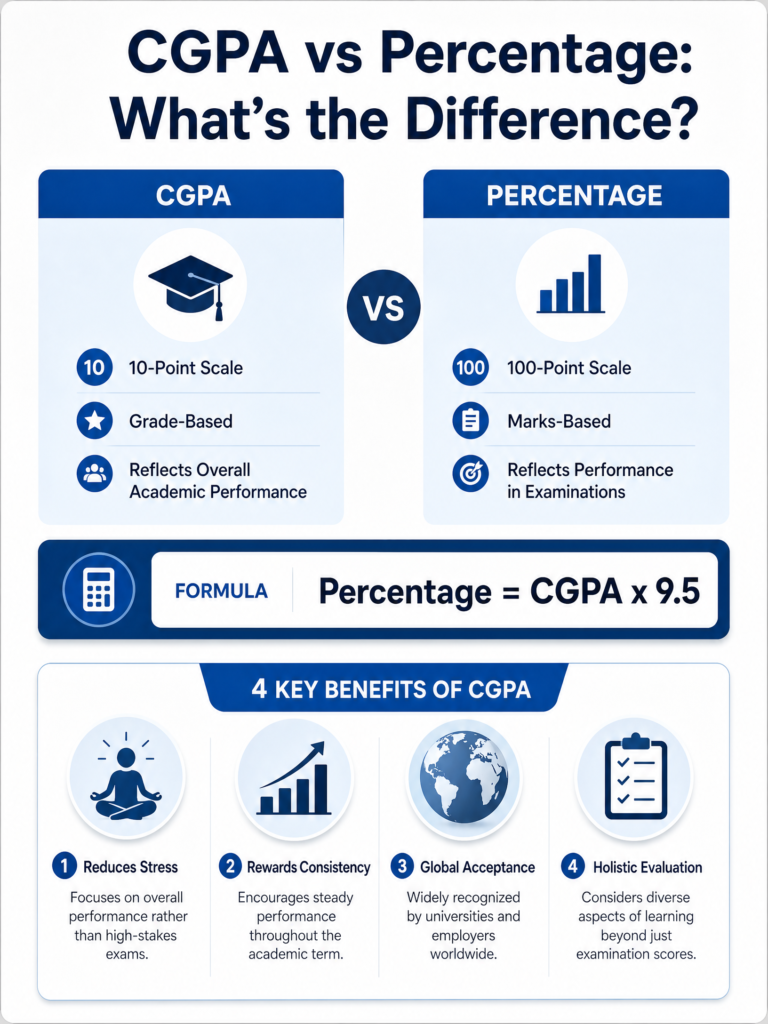
Since many students need both figures at different points, converting between the two is a common requirement. The standard, most widely referenced formula uses a 9.5 divisor.
| Conversion Direction | Formula | Example |
|---|---|---|
| Percentage to CGPA | CGPA = Percentage / 9.5 | 85% ÷ 9.5 = 8.95 CGPA |
| CGPA to Percentage | Percentage = CGPA × 9.5 | 8.5 CGPA × 9.5 = 80.75% |
You can perform this conversion instantly using our free calculator, or refer to our complete Percentage to CGPA guide with worked examples for a deeper breakdown of the formula and multiple worked examples.
6. Which One Is ‘Better,’ CGPA or Percentage?
Neither system is objectively better, they simply represent the same underlying academic performance through different lenses. The right question is not which one is superior, but which one your specific application, institution, or scholarship requires.
| The Simple Way to Think About It:Percentage is like reading an exact temperature (23.4 degrees). CGPA is like reading a weather description (mild). Both are useful, both describe the same underlying reality, and which one you need depends entirely on the context you are working with. |
7. Common Situations Where the Difference Matters
| Situation | Which Figure Is Usually Needed |
|---|---|
| Indian school board report cards (CBSE) | CGPA, often needs conversion to percentage for other uses |
| Indian university undergraduate applications | Both, depending on the specific university’s requirement |
| International university applications (UK, US, Canada, Australia) | Usually GPA or CGPA equivalent, sometimes percentage |
| Scholarship eligibility criteria | Varies, always check the specific scholarship’s stated requirement |
| Job application academic qualification sections | Either, sometimes both are requested |
| Visa and immigration academic documentation | Often requires an official equivalency certificate, not self-calculated |
8. Common Mistakes When Working With CGPA and Percentage
Confusing CGPA with GPA, using the wrong conversion divisor, and submitting self-calculated figures on formal documents without verification are among the most frequent errors students make. We cover these in detail in our guide on 10 common CGPA calculation mistakes students make, along with exactly how to avoid each one.
People Also Ask
Is CGPA the same as percentage?
No, they are different ways of expressing the same underlying academic performance. Percentage is a precise score out of 100 based on exact marks. CGPA is a grade-point average, typically out of 10, that groups performance into bands rather than exact marks. They measure the same thing but present it differently, and one can be converted to the other using a standard formula.
Which is better for university admission, CGPA or percentage?
Neither is inherently better, universities specify which one they require, and many accept either with a conversion. Some international universities specifically prefer GPA or CGPA formats because they are more familiar with grade-point systems for comparing applicants globally. Always check your target university’s specific admission requirements rather than assuming one format is universally preferred.
How do I convert my CGPA to percentage?
Multiply your CGPA by 9.5 to get your approximate equivalent percentage. For example, a CGPA of 8.5 converts to 8.5 times 9.5, which equals 80.75%. You can get this instantly using our free calculator, which handles the conversion in both directions.
Why did CBSE switch from percentage to CGPA?
CBSE introduced CGPA partly to reduce the intense academic pressure and competition created by percentage-based scoring, where students would fixate on marginal differences of a single mark. By grouping performance into grade bands, CGPA was intended to reflect overall academic capability while reducing the stress of chasing exact percentage points.
Do all countries use CGPA instead of percentage?
No. Grading systems vary significantly by country and even by individual institution within the same country. Percentage-based grading remains common in many education systems. CGPA (commonly on a 10-point scale) is widely used in India and some other countries, while GPA (commonly on a 4-point scale) is the standard in the United States and several other countries.
Frequently Asked Questions
Can my CGPA and percentage give different impressions of my performance?
In rare cases, yes, because CGPA groups scores into bands, two students with slightly different percentages (say 84% and 86%) could end up with the exact same CGPA if both fall within the same grade band. This is intentional, CGPA is designed to smooth out very small differences rather than precisely reflect every fractional percentage point.
Should I report my CGPA or percentage on my resume?
Report whichever figure is more commonly expected in your field or region, or include both if space allows. For international job applications, especially those handled by recruiters unfamiliar with your specific education system, providing both figures (with a brief conversion note) removes any ambiguity.
Is there an official global standard for converting CGPA to percentage?
No single global standard exists. The 9.5 divisor is the most widely referenced formula in India, but different countries, boards, and universities use their own methodologies. Always verify the specific formula your target institution requires for anything formal. Our guide covers the standard 9.5 formula along with alternative scales used by different institutions.
Does a higher CGPA always mean a higher percentage?
Generally yes, since both scales move in the same direction, a higher CGPA corresponds to a higher percentage range. However, because CGPA groups scores into bands, the exact percentage equivalent of a given CGPA can vary slightly depending on where within that band your actual marks fall.
What should I do if a form does not specify whether it wants CGPA or percentage?
When a form is ambiguous, provide both figures with a brief note, such as ‘85% (CGPA 8.95 on standard 9.5 scale).’ This removes any confusion for whoever is reviewing your application. You can generate both figures instantly using our converter.
| Need to Convert Between CGPA and Percentage?Get an instant, accurate conversion in either direction, completely free.>>> Try the Free Percentage to CGPA Converter <<<Browse more guides on our Blogs page |