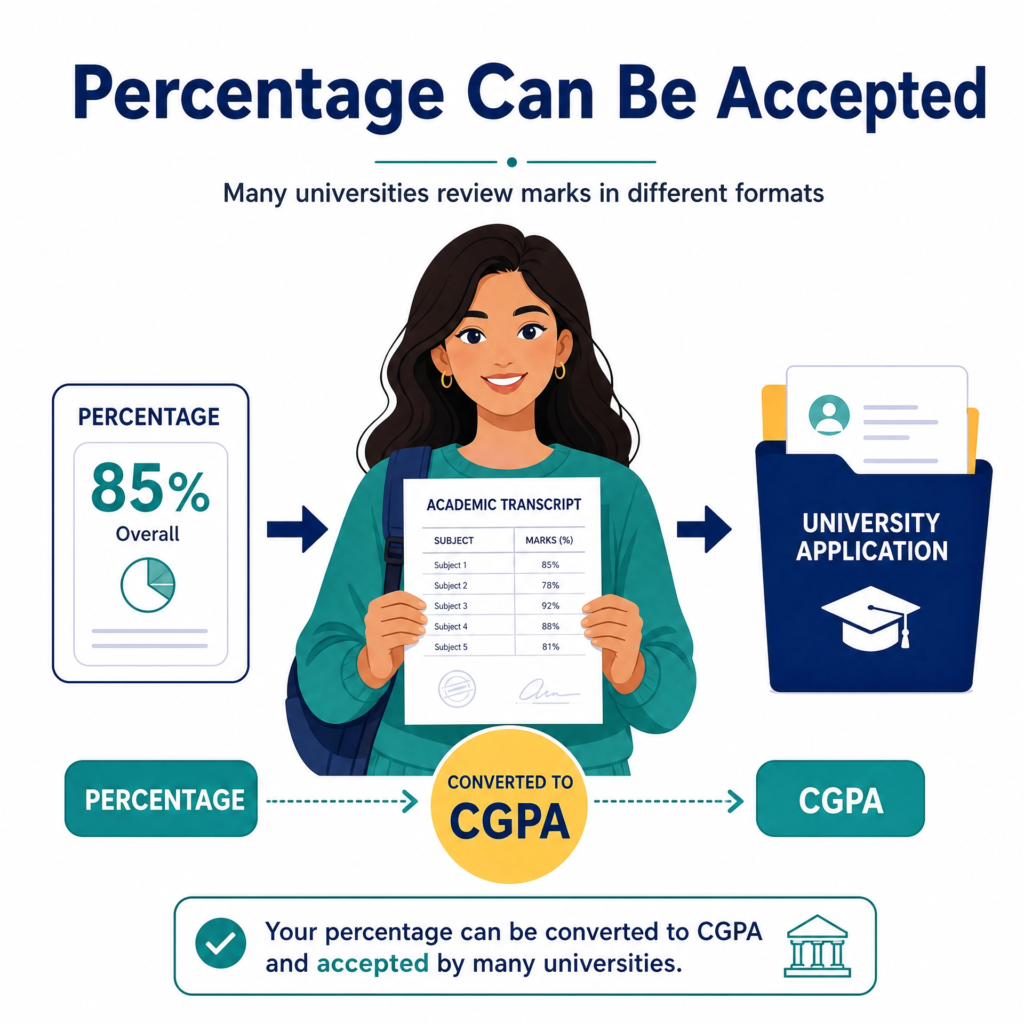
Yes — most graduate schools worldwide accept percentage instead of CGPA, but the process differs by country. UK and Australian universities accept Indian percentage scores directly and understand the grading system. US and Canadian universities typically require the percentage to be converted to a GPA on the 4.0 scale — either through a WES (World Education Services) evaluation or through the admissions office’s own internal conversion. German universities use the Anabin database for conversion. No institution rejects an application simply because the applicant submitted a percentage rather than a CGPA — the question is how they process it.
| Quick Answer: UK, Australia, and New Zealand accept Indian percentage directly. USA and Canada require conversion to 4.0 GPA — usually through WES evaluation (USD 100 to 200). Germany uses the Anabin database. No graduate school rejects percentage outright — they convert it to their own scale. Submit your official transcript and check whether a WES evaluation is required. |
| YesUK and Australia accept % directly | WESMost US programs require evaluation | $100-205WES evaluation cost (USD) | 75%= First Class UK = 3.3 GPA US |

Why This Question Exists — The CGPA vs Percentage Problem
Indian universities use two main grading formats: percentage (marks obtained as a proportion of maximum marks) and CGPA (a grade point average on a 10-point scale). Different institutions use different formats — some print only percentage on the marksheet, some print only CGPA, and some print both. When students apply abroad, they encounter application forms that ask for GPA on a 4.0 scale — a system used primarily in North America that does not naturally align with either Indian percentage or Indian CGPA.
This creates genuine confusion. A student with 78% on their marksheet looks at an application field that says GPA (out of 4.0) and does not know what to enter. Should they write 78? Should they convert it? Should they leave it blank and explain? The answer depends on the country, the institution, and whether a third-party evaluation is required.
The good news is that this is a well-understood situation in graduate admissions worldwide. Tens of thousands of Indian students apply to international programs every year. Every major graduate school has a clear policy on how they handle non-GPA grading systems, and percentage is not an obstacle to admission. It is simply a format that needs to be presented correctly.
—-
Country-by-Country: Does This Graduate School Accept Percentage?
Here is the complete breakdown of how each major destination country handles Indian percentage in graduate admissions:
| Country | Accepts %? | Preferred Format | What Actually Happens |
| USA | Yes — with conversion | GPA on 4.0 scale | Admissions offices convert % to GPA internally or request WES evaluation |
| Canada | Yes — with conversion | GPA on 4.0 scale | WES Canada evaluation often required for Indian applicants |
| UK | Yes — directly | Percentage directly | UK uses % classification — First Class (70%+), 2:1 (60-69%). Indian % maps naturally |
| Australia | Yes — directly | Percentage directly | Australian universities use % and understand Indian marksheets well |
| Germany | Yes — with conversion | German grade (1-5 scale) | Anabin database used — Indian % converted to German grade equivalent |
| Netherlands | Yes — with conversion | Dutch 10-point scale | Nuffic evaluation service converts Indian grades to Dutch equivalent |
| Singapore | Yes — mostly directly | CGPA or % accepted | NUS, NTU, SMU familiar with Indian grading — review % or CGPA |
| India (domestic PG) | Yes — directly | Percentage directly | All domestic PG programs (MBA, MS, MTech) use % as primary criterion |
| Japan | Varies by university | JLPT + GPA | Many programs accept % with academic transcript — check individually |
| New Zealand | Yes — directly | Percentage directly | NZQA framework familiar with Indian academic system |
—-
How US Graduate Schools Process Indian Percentage
The United States is where the percentage-to-GPA conversion question most commonly creates confusion. US graduate programs use the 4.0 GPA scale as their standard academic measurement, and their application forms are built around it. However, no US graduate school expects international applicants to have a 4.0 scale GPA on their transcript — they are entirely familiar with evaluating international academic records.
Option 1 — WES Evaluation (World Education Services)
WES is the most widely recognised credential evaluation service for US and Canadian graduate admissions. When you submit a WES evaluation, WES reviews your official transcript, applies their own conversion formula, and issues a report that states your equivalent US GPA on the 4.0 scale. Most admissions offices treat a WES evaluation as the definitive conversion and use the GPA stated in the WES report rather than doing their own calculation.
WES evaluation costs between USD 100 and USD 205 depending on the service level, and typically takes 7 to 14 business days after receiving your documents. For applications to competitive US programs, applying for WES evaluation early — at least 6 to 8 weeks before your application deadline — is strongly recommended.
Option 2 — Self-Reported Conversion on Application
Many US application portals (including the Common Application and many university-specific portals) allow applicants to select their grading scale from a dropdown and enter their score in its original format. You can select Percentage as the scale, enter 78, and the admissions office will apply their own internal conversion. This is accepted practice and does not disadvantage your application.
When using this option, also upload your university’s grading scale document — a one-page document from your registrar that explains what percentage range corresponds to what grade and grade point in your institution’s system. Most registrars provide this free of charge.
Option 3 — Program-Specific Requirements
Some US programs explicitly state in their admissions requirements that a WES or equivalent evaluation is mandatory. Others state it is optional. Check each program’s admissions FAQ page individually. If the requirement is unclear, email the graduate admissions office directly and ask whether a third-party evaluation is required for Indian applicants — they will answer quickly and definitively.
Where Does 75% Stand for US Graduate Admissions?
| University | Min GPA (4.0) | 75% Equivalent | Notes for Indian Applicants |
| MIT | 3.5+ preferred | 3.3 — below typical | Research output and publications compensate; WES required |
| Stanford | 3.5+ preferred | 3.3 — below typical | Strong SOP + LOR + research needed to compensate |
| Top-20 US Universities | 3.3 to 3.5 | 3.3 — borderline | 75% is competitive but not guaranteed — strong profile needed |
| Top-50 US Universities | 3.0 to 3.3 | 3.3 — competitive | 75% qualifies comfortably — focus on test scores and SOP |
| State Universities (general) | 2.5 to 3.0 | 3.3 — strong | 75% is well above minimum — high admission probability |
| Community College Transfer MS | 2.5 minimum | 3.3 — very strong | 75% is highly competitive for this pathway |
How UK Graduate Schools Process Indian Percentage
The United Kingdom uses a percentage-based degree classification system: First Class (70% and above), Upper Second or 2:1 (60 to 69%), Lower Second or 2:2 (50 to 59%), and Third Class (40 to 49%). This maps naturally to Indian percentage scores without any conversion required.
UK admissions offices understand Indian academic transcripts well — India has been a major source of international students for UK universities for decades. When you submit an application to a UK postgraduate program, you simply state your percentage as it appears on your marksheet and submit your official transcript. The admissions office places your percentage in the corresponding UK classification bracket.
A 75% score from an Indian university places comfortably in the First Class bracket, which meets or exceeds the minimum requirement for most UK MSc, MA, and postgraduate diploma programs — including programs at Russell Group universities. You do not need a WES evaluation for UK applications.
| UK Tip: When applying to UK programs, state your percentage exactly as it appears on your official marksheet. Also submit your university’s grading scale document if applying to a highly competitive program — this confirms that your 75% is equivalent to First Class under your institution’s system. |
—-
How Australian Graduate Schools Process Indian Percentage
Australian universities are among the most internationally experienced in processing Indian academic transcripts. Australia has a large Indian student population and well-established processes for evaluating Indian qualifications. Australian graduate programs accept Indian percentage scores directly and apply their own classification system — High Distinction (typically 85% and above), Distinction (75 to 84%), Credit (65 to 74%), and Pass (50 to 64%).
There is no mandatory third-party evaluation for most Australian graduate programs. Submit your official transcript, which will show your percentage or CGPA, and Australian admissions offices will evaluate it directly. Some programs may request a document explaining your university’s grading system — your registrar can provide this at no cost.
A 75% score from an Indian university maps to the Distinction band in the Australian system, which comfortably meets entry requirements for most Australian MS, MEng, and professional master’s programs. Many programs require 60 to 65% minimum for entry.
—-
How German Graduate Schools Process Indian Percentage
Germany uses a 5-point grading scale (reversed from what most systems use — 1.0 is best, 5.0 is fail) and relies on the Anabin database to evaluate international qualifications. The Anabin database is maintained by the German Academic Exchange Service (DAAD) and contains evaluation data for universities and grading systems from around the world, including Indian institutions.
German universities typically do not require a WES evaluation. Instead, they use the modified Bavarian formula to convert Indian percentage or CGPA to German grade equivalents. Under this formula, a 75% Indian score converts to approximately 2.3 on the German scale — which falls in the Good category and meets entry requirements for most German public university master’s programs.
Germany is an increasingly popular destination for Indian engineering and science students because most public university programs have no tuition fees. Competition for English-taught master’s programs has increased significantly, and German language proficiency (at least B1 or B2 level) is increasingly expected even for English-medium programs, as it affects daily life and internship opportunities.
—-
Percentage to GPA Conversion Table — Graduate School Reference
Use this table to understand exactly where your Indian percentage stands across major graduate school grading systems:
| Percentage | CGPA (÷9.5) | US GPA (4.0) | UK Class | Grad School Fit | WES Typical |
| 90%+ | 9.47+ | 4.0 | First Class | MIT / Ivy League | 4.0 |
| 85-89% | 8.95-9.37 | 4.0 | First Class | Top-20 US | 3.9-4.0 |
| 80-84% | 8.42-8.84 | 3.7 | First Class | Top-30 US | 3.7-3.8 |
| 75-79% | 7.89-8.31 | 3.3 | First Class | Top-50 US | 3.3-3.5 |
| 70-74% | 7.36-7.78 | 3.0 | 2nd Class Upper | State Universities | 3.0-3.3 |
| 65-69% | 6.84-7.26 | 2.7 | 2nd Class Upper | General programs | 2.7-3.0 |
| 60-64% | 6.31-6.73 | 2.3 | 2nd Class Lower | Limited options | 2.3-2.7 |
| Below 60% | Below 6.31 | Below 2.0 | 2nd Class Lower | Very limited | Below 2.3 |
For an instant accurate conversion of any percentage to CGPA and GPA equivalent, use the free calculator at percentage2cgpa.site.
—-
What Documents Should You Submit With Your Graduate Application?
The exact documents required vary by program, but this table covers the standard requirements for Indian applicants applying internationally:
| Document | Purpose | Where Required | Cost (approx) |
| Official Transcripts | Shows all grades, credit hours, GPA/percentage as awarded by university | All graduate programs worldwide | Free to $50 (university admin fee) |
| WES Evaluation (USA/Canada) | Converts Indian grades to US GPA equivalent — official third-party evaluation | Most US and Canadian programs | USD 100 to 205 |
| Percentage-to-CGPA conversion letter | University-issued letter explaining their grading system and your score | Some US/UK programs that ask for clarification | Free from registrar |
| Grading scale document | Official document showing what grade corresponds to what score range | Requested by many US admissions offices | Free from university |
| Statement of Purpose (SOP) | Contextualises your academic performance, explains any weak semesters | All graduate programs | Free — your time |
| IELTS / TOEFL / GRE | English proficiency and academic aptitude — can compensate for lower grades | Most international programs | USD 150 to 230 per test |
How to Write Your Percentage on a Graduate Application Form
When an application form asks for GPA and you have a percentage, follow this approach:
- If the form has a scale dropdown, select Percentage or Other and enter your percentage as a number (78, not 78%)
- If the form only has a GPA field with a maximum of 4.0, enter your converted GPA equivalent (78% = 3.5 on WES scale approximately) and note in the additional information section that your original score is 78% on a percentage scale
- If the form asks to upload a transcript, upload your official marksheet and also upload your university’s grading scheme document
- Never inflate your score — if your percentage is 72.4%, enter 72.4, not 73 or 75
- If in doubt, contact the admissions office and ask directly — they appreciate candidates who ask rather than guess
—-
Graduate Programs — Does 75% Actually Qualify You?
Here is a realistic assessment of how 75% positions you across popular graduate programs:
| Program / Country | Min % / CGPA Required | 75% Qualifies? | Application Tips for Indian Students |
| MS Computer Science (USA, top-50) | 60-65% / 3.0 GPA | Yes — strongly | Strong GRE and GitHub portfolio strengthen the application |
| MBA (USA, top-20) | 65%+ / 3.3 GPA | Yes — competitive | GMAT score, work experience, and leadership examples matter most |
| MSc (UK, Russell Group) | 60% / 2:1 minimum | Yes — First Class | 75% comfortably meets most UK MSc requirements — submit % directly |
| MTech (IITs, India) | 60% + GATE score | Yes | GATE score is primary filter — 75% percentage meets eligibility easily |
| Masters (Germany, public unis) | 65% / 6.5 CGPA equiv. | Yes | No tuition fees — Anabin evaluation needed, motivation letter critical |
| MS / MEng (Australia) | 60-65% / Distinction | Yes — comfortably | Australian PR pathway makes this popular — English score + transcript needed |
| Masters (Canada, top schools) | 70% / 3.0 GPA | Yes — at threshold | WES Canada evaluation required — research statement adds weight |
| MBA (India, IIMs) | 50% min, CAT/GMAT score | Yes — above min | Entrance exam score (CAT) is the primary filter — % is secondary |
—-
What If Your Percentage Is Below What the Program Requires?
A percentage that falls below a program’s stated minimum is not automatically disqualifying — but it requires a stronger overall application profile. Graduate admissions decisions are holistic, and several factors can compensate for a lower academic percentage:
Factors That Can Compensate for a Lower Percentage
- Strong GRE or GMAT scores — particularly in programs where quantitative ability matters (engineering, data science, finance)
- Relevant work experience — especially for MBA and professional master’s programs where industry background is valued
- Research experience — publications, conference papers, thesis work, or research assistant positions strengthen an academic application significantly
- Strong Statement of Purpose — a compelling, specific narrative about why this program, why this university, and what you will bring to the cohort
- Letters of Recommendation from credible academic or professional sources who can speak specifically to your capabilities
- A strong performance trend — if your percentage improved significantly in later semesters, the SOP is the place to highlight this trajectory
Should You Apply Despite Being Below the Minimum?
Published minimum requirements are typically soft floors, not hard cutoffs. Admissions committees review the full application. A candidate with 65% who has a strong research background, a well-written SOP, excellent recommendations, and a high GRE score may well be selected over a candidate with 78% who has a generic application. Apply to programs where your full profile is competitive — not just where your percentage meets the minimum.
—-
What People Search About Graduate Schools and Percentage Acceptance
These are real search queries students use in 2026:
- Do US universities accept percentage instead of CGPA?
- Do UK graduate schools accept Indian percentage?
- How to convert Indian percentage to GPA for US applications
- Is WES evaluation mandatory for US MS applications?
- Do Australian universities accept Indian percentage?
- How does Germany evaluate Indian percentage for Masters?
- What GPA is 75% for US graduate schools?
- Can I apply to graduate school with percentage instead of CGPA?
- Do I need to convert my percentage before applying abroad?
- What documents do I need to submit percentage to grad school?
—-
Frequently Asked Questions
Do graduate schools accept percentage instead of CGPA?
Yes — all major graduate school destinations accept percentage, though the process varies. UK and Australian universities accept Indian percentage directly with no conversion needed. US and Canadian programs typically require conversion to a 4.0 GPA scale — either through WES evaluation or via the application portal’s own conversion. Germany uses the Anabin database. No institution rejects an application because it shows percentage rather than CGPA.
Do I need a WES evaluation to apply to US graduate schools with my Indian percentage?
Many US programs require a WES or equivalent evaluation for Indian applicants. However, requirements vary by program — some accept self-reported conversions through the application portal, others require an official third-party evaluation. Check each program’s admissions requirements page individually. For competitive programs, getting a WES evaluation early (USD 100 to 205, takes 7 to 14 days) is recommended regardless of whether it is strictly required.
How do I convert my Indian percentage to GPA for graduate school applications?
For US and Canadian applications: divide your percentage by 9.5 to get your Indian CGPA, then use the standard GPA conversion table (75% approximately equals 3.3 GPA on a 4.0 scale). For a WES-recognised conversion, submit your documents to WES and use their official report. For UK applications, submit your percentage directly — no conversion needed. For Australia, submit your percentage directly. For Germany, the Anabin database handles conversion.
Is 75% good enough for graduate school abroad?
Yes — 75% is a strong academic result that qualifies for most international graduate programs. In the UK, it places you in First Class (70%+). In Australia, it falls in the Distinction band. For US programs, it converts to approximately 3.3 GPA on the 4.0 scale — competitive for most state universities and many top-50 programs. For top-20 US programs and Ivy League, 75% is borderline and would require a strong overall application profile to complement it.
Do I need to convert my percentage to CGPA before applying to graduate school?
No — you do not need to convert it yourself before applying. Submit your percentage exactly as it appears on your official marksheet. For US applications, the WES evaluation or the application portal will handle the conversion. For UK and Australian applications, no conversion is needed. Converting your own percentage and submitting the converted figure without an official evaluation can raise questions — always submit the original score from your official document.
What is the minimum percentage required for MS in the USA?
Most US state universities require a minimum equivalent of 60 to 65% (approximately 2.5 to 3.0 GPA on the 4.0 scale). Top-50 programs typically prefer 65 to 70% (3.0 to 3.3 GPA). Top-20 and elite programs prefer 75%+ (3.3 to 3.7 GPA equivalent). These are guidelines — a holistic application with strong GRE scores, relevant work experience, and a well-written SOP can compensate for a percentage that is below the preferred range.
—-
More Tools and Guides on percentage2cgpa.site
| Anchor Text | URL |
| Free Percentage to CGPA Converter | https://percentage2cgpa.site/ |
| 10 Common CGPA Calculation Mistakes | https://percentage2cgpa.site/blogs/ |
| What Is 70% in CGPA on a 4.0 Scale? | https://percentage2cgpa.site/blogs/ |
| How to Improve Your CGPA | https://percentage2cgpa.site/blogs/ |
| What’s My Final CGPA if Percentages Vary? | https://percentage2cgpa.site/blogs/ |
Check Your Percentage in Every Global Grading System — Instantly
Use the free converter at percentage2cgpa.site — enter your percentage and get your Indian CGPA, US GPA equivalent, UK classification, and letter grade all in one step. Free, instant, no sign-up.
Sources and References
WES World Education Services official evaluation guidelines · UCAS UK Undergraduate and Postgraduate Admissions · Universities Australia international student admissions guidelines · DAAD German Academic Exchange Service — Anabin database · QS World University Rankings admissions data 2026 · Individual university admissions pages (MIT, Stanford, UCL, University of Melbourne) · percentage2cgpa.site standard 9.5 scale formula
