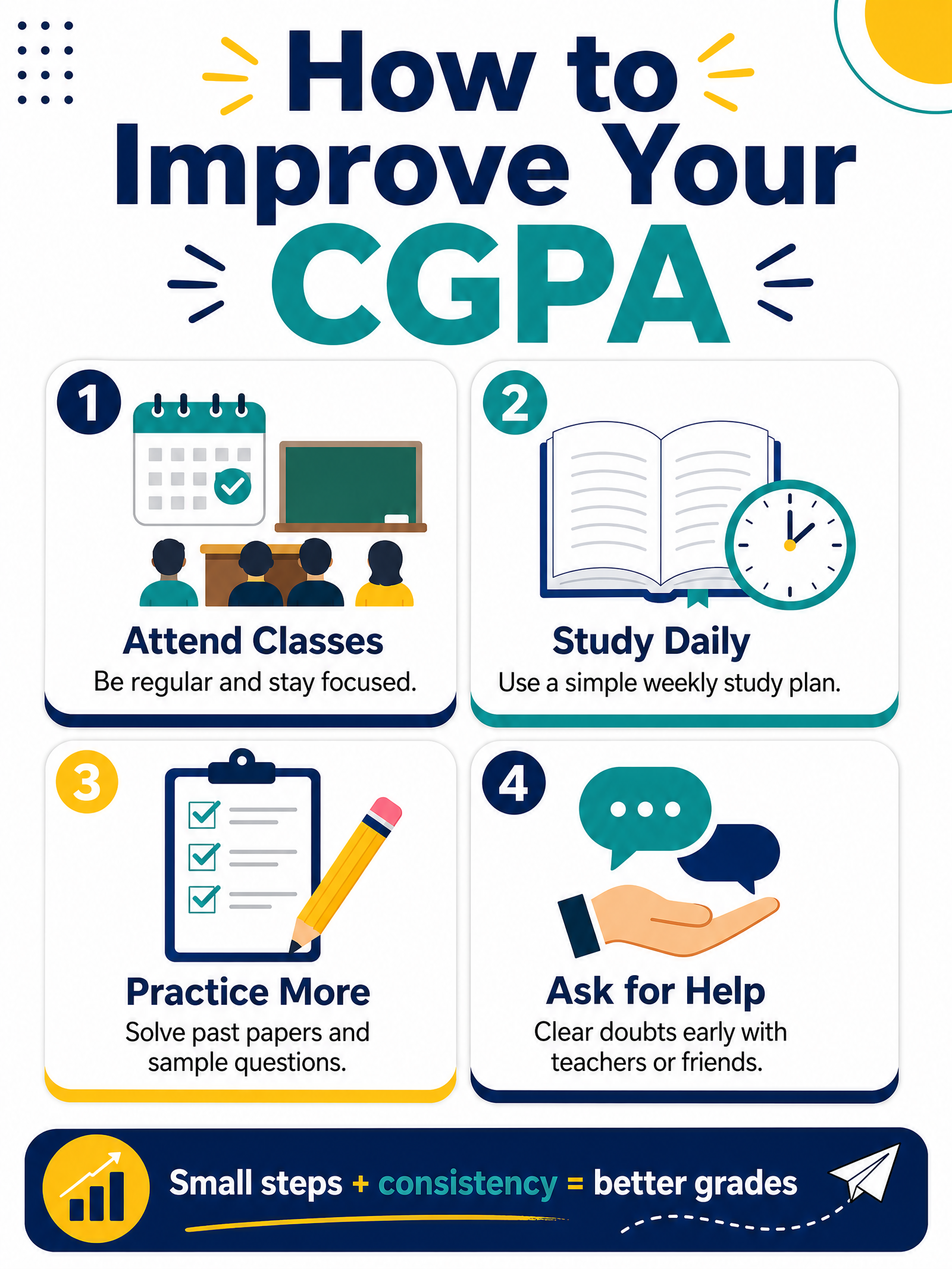
You can improve your CGPA — but the earlier you start, the more you can gain. CGPA improvement works through the mathematics of weighted averages: each new semester’s grades are added to your cumulative record, and the more semesters you have remaining, the more impact each good semester has. The 10 strategies in this guide are the ones that consistently produce results — from choosing the right subjects to fixing internal assessment marks before exams even begin.

| Quick Answer: To improve your CGPA, focus on three things first: understand how credit-weighted averages work so you target the right subjects, fix your internal assessment marks which contribute 20 to 40 percent of your grade, and start early because one bad semester early matters more than two bad semesters late. |
| 28Days for skin cell turnover — same time it takes to build a study habit | +1.7CGPA gain possible over 5 semesters with consistent effort | 40%of your grade often comes from internal assessments | 9.5Standard divisor to convert percentage to CGPA in India |
Why CGPA Improvement Feels Slow — And Why That Is Normal
The biggest frustration students have with CGPA improvement is this: you work extremely hard for one semester, score a 9.0, and your CGPA barely moves. It went from 6.4 to 6.7. That feels discouraging — and it makes many students give up.
What they are experiencing is not failure. It is mathematics. CGPA is a cumulative weighted average. If you have completed 100 credits at a 6.4 CGPA and you score a 9.0 in a 25-credit semester, your new CGPA is approximately 7.0 — a 0.6 improvement, not a jump to 9.0. The weight of your past performance pulls the average down. This is not a bug in the system. It is exactly how averages work.
The implication is important: the earlier in your degree you improve, the bigger the impact each good semester has. A student who improves from Semester 2 has six or seven semesters to build on that improvement. A student who starts improving in Semester 7 has one semester left — and even a perfect 10.0 cannot move the needle much.

| Students who begin CGPA improvement strategies in their second or third semester consistently achieve 1.5 to 2.0 CGPA points of gain by graduation. Students who start in their sixth or seventh semester typically gain only 0.2 to 0.4 CGPA points regardless of effort. Start now. |
—-
How Much Can You Actually Improve? A Realistic Breakdown
Before the strategies, you need a realistic picture of what is achievable based on where you are now:
| Current CGPA | Semesters Left | Realistic Target | Required Sem GPA | Difficulty |
| 5.0 | 6 | 6.5 | 8.0+ per semester | Hard but possible |
| 6.0 | 4 | 7.0 | 8.5+ per semester | Achievable |
| 7.0 | 4 | 7.8 | 8.8+ per semester | Achievable |
| 7.5 | 2 | 7.9 | 8.5+ per semester | Requires full focus |
| 8.0 | 2 | 8.3 | 9.0+ per semester | Very achievable |
| Any CGPA | 1 | Minimal change | Even 10.0 barely moves it | Work on other profile areas |
To calculate your projected CGPA after improvement, use the free CGPA calculator at percentage2cgpa.site — enter your current CGPA, credits completed, and expected semester GPA to see your projected outcome instantly.
—-
10 Proven Strategies to Improve Your CGPA
Strategy 1: Target High-Credit Subjects First
Not all subjects affect your CGPA equally. A 4-credit core subject carries twice the weight of a 2-credit elective. If you have limited study time, it should go to your highest-credit subjects first. A grade improvement in a 4-credit subject moves your CGPA roughly twice as much as the same improvement in a 2-credit subject. Most students spread their effort evenly across all subjects without realising this — and it is one of the most costly CGPA mistakes they make.
| Quick action: List all your current semester subjects by credit hours. Study the 4-credit subjects first, every week, without exception. |
Strategy 2: Fix Your Internal Assessment Marks — Before Exams
In most Indian universities, internal assessment marks contribute 20 to 40 percent of your final grade. This includes assignments, class tests, attendance, lab records, and presentations. These marks are earned before the final exam — which means you can secure a significant portion of your grade before sitting in the exam hall. Many students ignore internals and try to compensate with exam performance. This is a harder path. Internals are more predictable and often easier to score well in with basic preparation.
| Quick action: Check your university’s internal assessment breakdown for each subject this week. Identify which components you are behind on and address them immediately. |
Strategy 3: Understand the Grading Boundary for Each Subject
Every university has grade boundaries — the score ranges that correspond to each grade point. For example, 75 to 84 marks might give you an 8 grade point, while 85 and above gives you a 9. Knowing these boundaries tells you exactly where to focus your effort. If you are scoring 72 in a subject, you are just below an 8 grade point. Three more marks earned strategically — from an internal test revision, a better lab record, or one question in the exam — moves you to the next grade boundary. Without knowing the boundary, you do not know where those three marks matter.
| Quick action: Download your university’s grading scheme and mark the boundary score for each subject. Calculate how far you are from the next grade point in each one. |
Strategy 4: Choose Electives Strategically — Not by Interest
Open electives and minor subjects are a significant CGPA opportunity that most students waste by choosing based on curiosity or peer recommendation. The smarter approach is to choose electives where you already have knowledge or aptitude — subjects where you can score near the top with less effort than a subject that is genuinely new to you. A 9.5 in an elective you are comfortable with contributes meaningfully to your CGPA. A 7.0 in an elective you chose because it sounded interesting does the opposite.
| Quick action: When selecting next semester’s electives, shortlist subjects that overlap with your existing knowledge base, past schooling, or personal interests where you already have depth. |
Strategy 5: Master the First Two Weeks of Each Semester
The first two weeks of any semester determine more about your final grade than most students realise. This is when syllabi are introduced, the scope of each subject becomes clear, and — in many universities — the first internal assessment period falls. Students who engage actively in the first two weeks understand what the professor emphasises, which topics will appear in assessments, and what study approach the subject requires. Students who drift through the first two weeks spend the rest of the semester catching up.

| Quick action: In the first week of every new semester, read the full syllabus of every subject and create a one-page study plan for each one. This takes four hours and pays off for four months. |
Strategy 6: Use Previous Year Question Papers as Your Primary Study Tool
Previous year question papers are the most reliable guide to what will appear in your exams — far more reliable than notes, textbooks, or coaching material. Universities repeat question patterns, topic emphasis, and even specific questions across years. A student who has solved five years of previous papers for a subject enters the exam knowing the likely structure, the commonly tested topics, and the approximate difficulty level. This is not cheating. It is efficient preparation that every topper uses.
| Quick action: For every subject this semester, find at least three years of previous question papers. Solve them under timed conditions two weeks before the exam. |
Strategy 7: Build a Relationship With Your Professors
This strategy is uncomfortable for many students — but it works. Professors who know you by name and know you are engaged are more likely to give you the benefit of the doubt in borderline assessment situations, more likely to help you understand difficult topics, and more likely to write strong recommendation letters that support your academic profile beyond just your CGPA. Attending class consistently, asking genuine questions, and visiting professors during office hours costs nothing and builds the kind of academic relationship that creates opportunities.
| Quick action: Identify one professor per semester whose subject matters most to your career interests. Attend their office hours once in the first month — not to ask for marks, but to ask one genuine question about the subject. |
Strategy 8: Re-Appear Strategically for Grade Improvement
Many universities offer grade improvement exams or supplementary exam opportunities where you can re-appear for a subject to improve your grade. If your university allows this and you scored poorly in a high-credit subject in a previous semester, this is one of the fastest ways to improve your CGPA retroactively. Check your university’s academic regulations specifically — the rules around grade improvement exams vary significantly. Some universities replace the grade; others take the best score. Some do not offer this at all.
| Quick action: Check your university’s website under Academic Regulations or Examination Rules for the specific policy on grade improvement or re-appear exams. |
Strategy 9: Track Your CGPA Every Semester — Not Just at Graduation
Students who check their CGPA only at the end of their degree have no opportunity to course-correct. Students who calculate their CGPA every semester — and simulate what their projected CGPA will be if they score specific grades next semester — make better decisions. They know exactly which subjects to prioritise, which electives to choose, and whether they are on track for their target CGPA. Tracking your CGPA is not just an administrative task. It is a planning tool.
| Quick action: After every semester result, use the percentage to CGPA converter at percentage2cgpa.site to recalculate your current CGPA and project your next semester’s outcome under different performance scenarios. |
Strategy 10: Fix Attendance Before It Costs You Marks
Attendance requirements are easy to dismiss until they become a problem. Most Indian universities require a minimum 75 percent attendance to sit the final exam. Falling below this threshold does not just mean you miss exam marks — it can mean zero for that subject, which is catastrophic for your CGPA. Beyond the threshold, many professors factor attendance into their internal assessment marks or their grade-boundary decisions. Maintaining strong attendance is one of the lowest-effort, highest-impact CGPA protection strategies available.
| Quick action: Track your attendance percentage for each subject every two weeks throughout the semester. Set a personal minimum of 85 percent — the buffer protects you from illness, emergencies, and university events. |

Semester-by-Semester CGPA Improvement: A Real Example
This table shows what consistent improvement looks like over time — starting from a 6.0 CGPA and applying the strategies above across six semesters:
| Semester | Starting CGPA | Semester GPA | New CGPA | Change |
| Sem 1 | Baseline | 6.0 (struggling) | 6.0 | Starting point |
| Sem 2 | 6.0 | 7.2 (improved) | 6.6 | +0.6 CGPA |
| Sem 3 | 6.6 | 7.8 (strong) | 7.0 | +0.4 CGPA |
| Sem 4 | 7.0 | 8.2 (excellent) | 7.3 | +0.3 CGPA |
| Sem 5 | 7.3 | 8.5 (excellent) | 7.5 | +0.2 CGPA |
| Sem 6 | 7.5 | 8.8 (outstanding) | 7.7 | +0.2 CGPA |
| Total gain | 6.0 | Consistent 8.0+ avg | 7.7 | +1.7 CGPA in 5 semesters |
Note: CGPA changes slow down as the number of completed credits increases. This is normal and expected. The total gain of 1.7 CGPA points over five semesters is achievable with consistent effort — but it requires sustained performance, not a single great semester.
—-
How Subject Credit Hours Affect Your CGPA — A Priority Guide
Understanding credit weightings helps you allocate study time where it matters most:
| Subject Type | Credits (typical) | CGPA Impact | Priority Level |
| Core / Major subjects | 4 credits | Very High | Top priority — never miss or underperform here |
| Lab or practical subjects | 2 credits | High | Easy marks — preparation pays off well |
| Elective subjects | 3 credits | Medium | Choose subjects you are confident in |
| Minor or open electives | 2 credits | Medium | Pick scoring subjects strategically |
| Audit / Non-credit courses | 0 credits | None | Does not affect CGPA — take freely |
| Key Principle: One grade point improvement in a 4-credit subject moves your CGPA by approximately 0.05 to 0.10 points depending on total credits completed. The same improvement in a 1-credit subject moves it by 0.01 to 0.02. Study time allocation should reflect this difference. |
—-
What People Search About Improving CGPA
These are real search queries students use in 2026:
- How to improve CGPA in engineering in India
- Can I improve my CGPA in the last semester?
- How much CGPA can I improve in one semester?
- How to increase CGPA from 6 to 7.5 in India
- Does CGPA improvement exam replace old grade?
- How to calculate projected CGPA after improvement
- Best ways to improve low CGPA for placements
- How to improve CGPA for MS applications abroad
- What CGPA is needed for government jobs in India?
- Is it possible to improve CGPA from 5 to 7 in 4 semesters?
—-
Frequently Asked Questions — How to Improve Your CGPA
Can I significantly improve my CGPA in the last semester?
Very little, unfortunately. If you have completed seven semesters at a low CGPA and have one semester left, even a perfect 10.0 in that final semester will move your CGPA by only 0.1 to 0.2 points — because your past 700 or more credits outweigh your final 20 to 25 credits. The most impactful CGPA improvement happens in early semesters when your cumulative credit count is still low. In the final semester, focus on other profile-building — projects, certifications, internships — that matter alongside CGPA.
How many CGPA points can I realistically improve in one semester?
Typically 0.3 to 0.8 CGPA points per semester if you score significantly higher than your current average. The exact gain depends on how many credits you have already completed — the more you have completed, the smaller the change. A student with 50 credits completed will see bigger per-semester swings than a student with 200 credits completed. Use the CGPA calculator at percentage2cgpa.site to simulate your specific situation.
Does CGPA improvement help for campus placements?
Yes — for getting past the initial filter. Most major IT companies (TCS, Infosys, Wipro, Accenture) require a minimum 6.0 to 7.5 CGPA for eligibility. If your CGPA is below their threshold, you will not be shortlisted regardless of your skills. Above the threshold, CGPA matters less — aptitude tests and interviews carry more weight. The goal is to clear the filter, not to maximise CGPA at the expense of everything else.
What is a realistic CGPA target for MS admissions in the US?
A CGPA of 7.5 or above on the 10-point scale (approximately 3.3 to 3.5 on the 4.0 scale via WES evaluation) is competitive for most US state universities and mid-ranked MS programs. For top-50 programs, 8.0 and above is preferred (approximately 3.5 to 3.7 on the 4.0 scale). For MIT, Stanford, or Ivy League, the competitive range is typically 8.5 and above with strong research experience alongside it.
Should I focus on CGPA or skills and projects?
Both matter — and they serve different purposes. CGPA is a filter: it determines whether you get considered at all for placements, scholarships, and graduate admissions. Skills and projects are differentiators: they determine whether you get selected once you are in the room. A student with 7.0 CGPA and a strong portfolio is more employable than a student with 9.0 CGPA and no projects. But the 9.0 CGPA student will be in more rooms to begin with. The right answer is to do enough for CGPA and enough for skills — not to sacrifice one for the other.
How do I convert my improved percentage to CGPA to track progress?
Use the standard formula: CGPA = Percentage divided by 9.5. For example, if your aggregate percentage improved to 75 percent, your CGPA is 75 divided by 9.5 which equals 7.89. For an instant calculation with any percentage, use the free tool at percentage2cgpa.site — it shows your CGPA, GPA equivalent on the 4.0 scale, and letter grade in one step.
—-
More Tools and Guides on percentage2cgpa.site
Free Percentage to CGPA Converter — percentage2cgpa.site
10 Common CGPA Calculation Mistakes Students Make — percentage2cgpa.site/blogs
What Is 70% in CGPA on a 4.0 Scale? — percentage2cgpa.site/blogs
—-
Anchor Text Suggestions for Internal Linking
Use these when linking to this post from other pages on percentage2cgpa.site:
- how to improve your CGPA
- CGPA improvement strategies for Indian students
- how to increase CGPA from 6 to 7.5
- can I improve CGPA in last semester
- CGPA improvement timeline by semester
- how credit hours affect CGPA improvement
- internal assessment marks and CGPA
- how to calculate projected CGPA
- CGPA required for MS in USA from India
- realistic CGPA improvement per semester
—-
Know Your CGPA — Then Improve It
Use the free calculator at percentage2cgpa.site to check your current CGPA, project your next semester outcome, and track your improvement over time. Free, instant, no sign-up required.
Sources and References
UGC Credit Framework for Higher Education in India · AICTE Grading Guidelines 2021 · CBSE Official Grading Policy · Anna University Academic Regulations 2021 · percentage2cgpa.site standard 9.5 scale formula · WES World Education Services GPA Conversion Chart