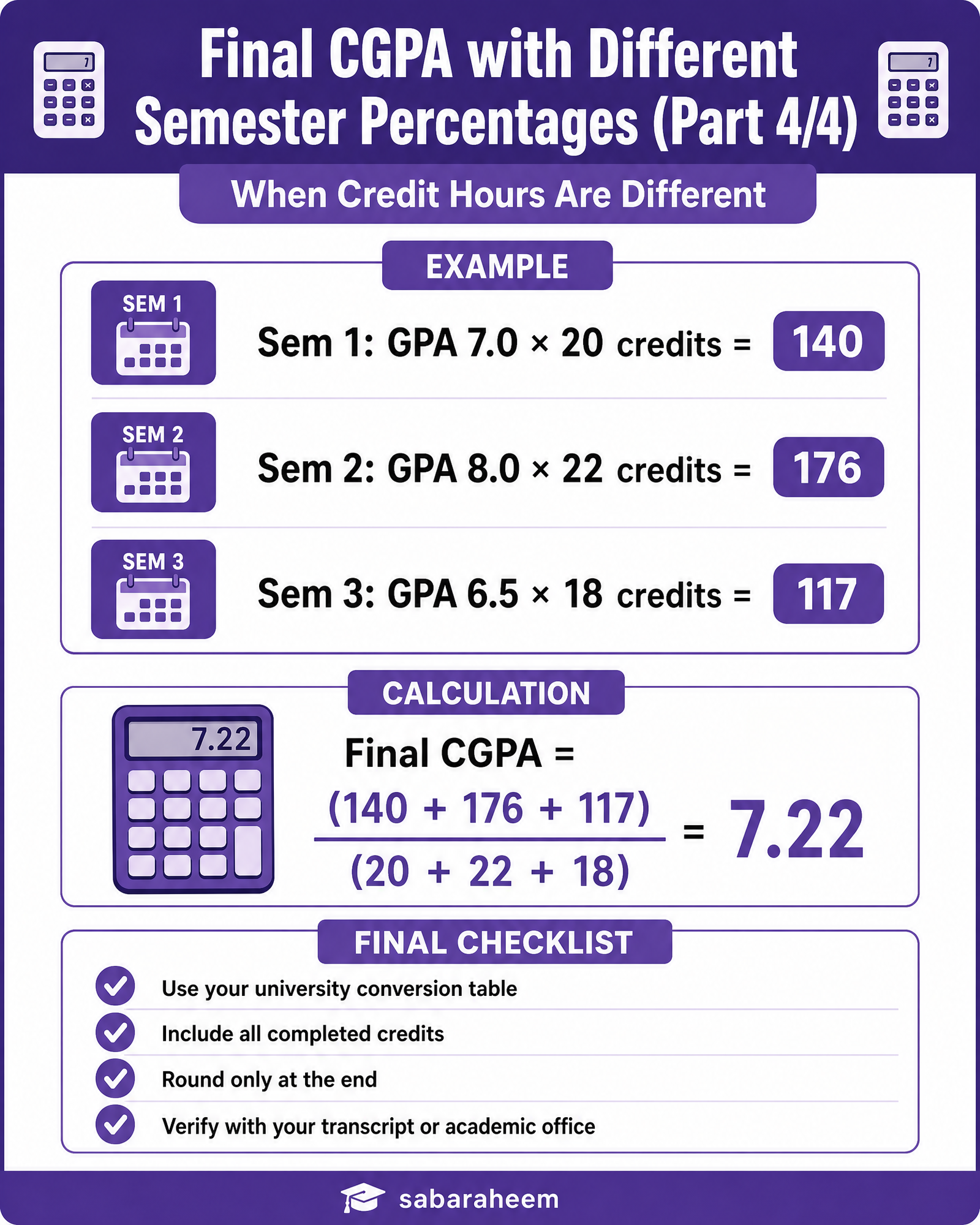
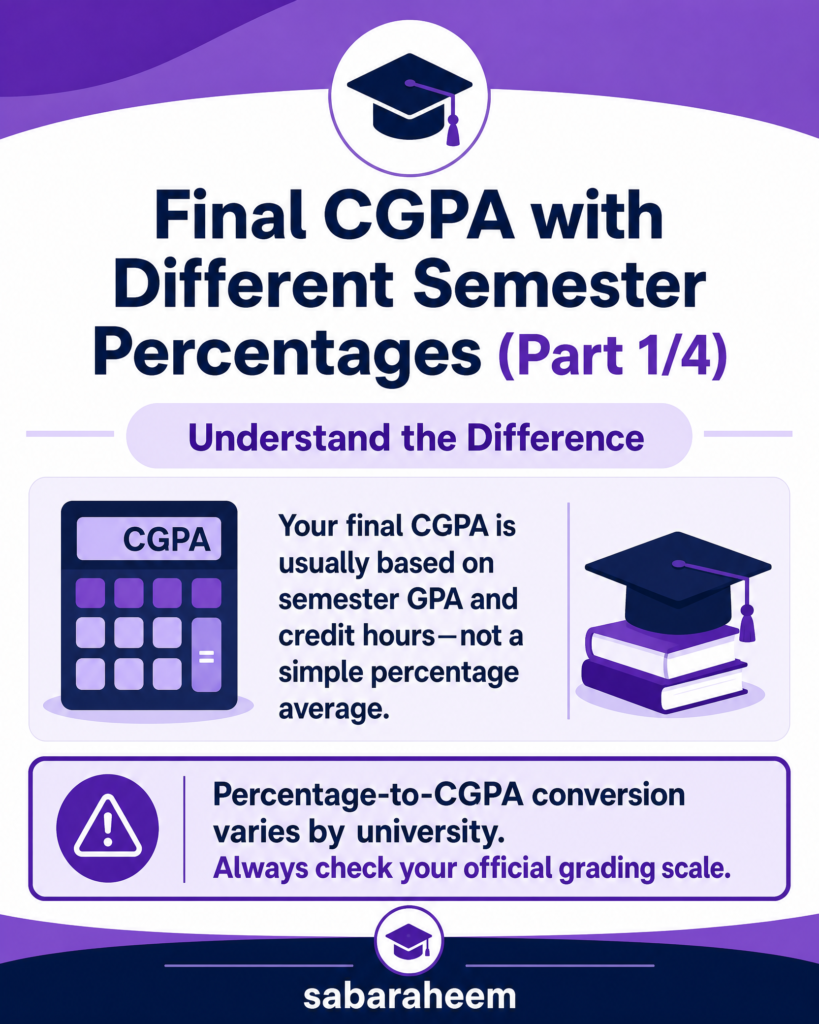
Your final CGPA when your percentage varies each semester is calculated using a credit-weighted average — not a simple average of your semester percentages. Each semester’s grade is multiplied by its credit hours, all results are added together, and the total is divided by your total credit hours across all semesters. The result is then converted to CGPA using your university’s divisor (usually 9.5 for Indian universities). A student who scored between 58% and 88% across eight semesters — a variation of 30 percentage points — can still finish with a 7.70 CGPA because the weighted formula accounts for each semester’s contribution accurately.
| Final CGPA = Sum of (Semester Percentage x Credits) divided by Total Credits, then divide by 9.5. You cannot just average your semester percentages — different semesters have different credit hours, so each semester must be weighted by how much it counts. |
| 9.5Standard Indian university divisor | 30%Variation range in worked example below | 7.70Final CGPA from 58-88% varying semesters | 7.89What 75% equals on the 9.5 scale |
Why Varying Semester Percentages Do Not Kill Your CGPA
The most common misconception students have is this — if I scored 58% in one semester, my CGPA is ruined. This is not true, and understanding why requires understanding how the cumulative weighted average actually works.
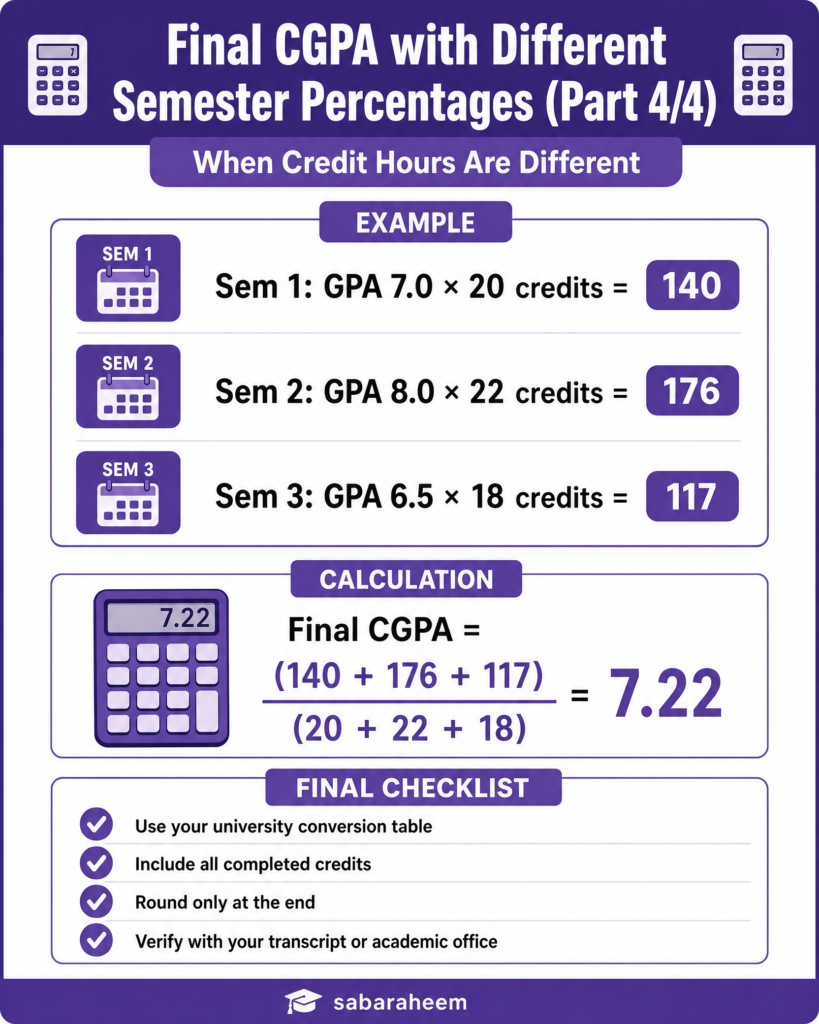
Your final CGPA is not an average of your semester percentages. It is a weighted average — where each semester’s percentage is weighted by the number of credits in that semester. A semester with 26 credits counts more than a semester with 20 credits. A strong performance in a heavy-credit semester can compensate significantly for a weaker performance in a lighter-credit semester.
The second key insight is that CGPA gets more stable as you progress through your degree. In Semester 1, a single bad exam can swing your CGPA dramatically because it represents 100 percent of your record. By Semester 7, that same bad semester represents less than 15 percent of your total credits — and its impact on your final CGPA is proportionally small.
| Students who improve their performance in later semesters consistently achieve better final CGPAs than their early results suggest — because credit-weighted averaging naturally rewards sustained improvement over time. The formula is designed to reflect your full academic journey, not just your worst moment. |
Real 8-Semester Example — Varying Percentages, Final CGPA
This worked example shows a student with significant semester-to-semester variation — ranging from 58% in their worst semester to 88% in their best — and how the credit-weighted formula produces a final CGPA:
| Semester | Percentage | Credits | CGPA (this sem) | Cumulative CGPA | Running Avg |
| Sem 1 | 62% | 24 | 6.52 (÷9.5) | 6.52 | 62% |
| Sem 2 | 71% | 26 | 7.47 (÷9.5) | 7.02 | 66.8% |
| Sem 3 | 58% | 24 | 6.10 (÷9.5) | 6.70 | 63.9% |
| Sem 4 | 79% | 26 | 8.31 (÷9.5) | 7.12 | 67.7% |
| Sem 5 | 83% | 25 | 8.73 (÷9.5) | 7.38 | 70.2% |
| Sem 6 | 76% | 25 | 8.00 (÷9.5) | 7.50 | 71.3% |
| Sem 7 | 88% | 24 | 9.26 (÷9.5) | 7.67 | 72.8% |
| Sem 8 | 81% | 24 | 8.52 (÷9.5) | 7.70 | 73.4% |
| FINAL CGPA | 73.4% avg | 198 total | Weighted avg | 7.70 / 10 | First Class |
Key observation: The student scored below 65% in two semesters (Semesters 1 and 3) but finished with a 7.70 CGPA — First Class — because their later semesters were stronger and because the credit-weighted formula meant their 88% Semester 7 performance carried significant weight. A simple average of their eight semester percentages would be 74.75%, giving 7.87 CGPA — close but not accurate, because it ignores the different credit weights.
To verify your own calculation instantly, use the free tool at percentage2cgpa.site — enter your semester percentages and credits to get your accurate weighted CGPA.
Step-by-Step Calculation: How to Find Your CGPA With Varying Percentages
Step 1 — List Every Semester’s Percentage and Credit Hours
From your marksheet, write down each completed semester, its aggregate percentage, and its total credit hours. Do not include non-credit courses, audit subjects, or S/U graded courses in this list.
Step 2 — Convert Each Semester Percentage to a Grade Point Score
For each semester: multiply the semester percentage by its credit hours. This gives you the weighted grade score for that semester.
| Example: Semester 1: 62% x 24 credits = 1,488 weighted score. Semester 2: 71% x 26 credits = 1,846 weighted score. |
Step 3 — Add All Weighted Scores Together
Sum up all the weighted scores from every semester. This is your total weighted grade point.
Step 4 — Divide by Total Credits
Divide your total weighted grade score by your total credit hours across all semesters. This gives you your overall percentage on a credit-weighted basis.
| Example: Total weighted score across 8 semesters = 14,521. Total credits = 198. Weighted average percentage = 14,521 / 198 = 73.34%. |
Step 5 — Apply Your University’s CGPA Formula
Divide your weighted average percentage by 9.5 (for most Indian universities). This is your final CGPA.
| Example: 73.34% / 9.5 = 7.72 CGPA. Verify this with your official marksheet — minor differences may occur due to how your university rounds intermediate values. |
How to Convert Percentage to CGPA: A Simple Guide
Converting percentage to CGPA is straightforward once you know which formula your university uses. Here is the complete step-by-step process:
The Standard Conversion Process
- Step 1 — Identify your university’s divisor. Most Indian universities use 9.5. Some use 9.0 or 10.0. Check your university’s academic regulations or ask your registrar.
- Step 2 — Take your aggregate or semester percentage. This should be your total marks obtained divided by maximum marks, expressed as a percentage.
- Step 3 — Divide the percentage by your university’s divisor. For 9.5 scale: CGPA = Percentage / 9.5.
- Step 4 — Round to two decimal places. Your CGPA should match what appears on your official transcript.
- Step 5 — Verify against your official marksheet. If there is a discrepancy, your marksheet is always the authoritative figure.
The Reverse — Converting CGPA Back to Percentage
When an application asks for percentage but you only have CGPA: Percentage = CGPA multiplied by 9.5. A CGPA of 7.89 converts back to 74.96%, which rounds to 75%.
Conversion Across Different Scales
Not all universities use the 9.5 divisor. Here is how the conversion changes across the most common scales:
- 9.5 scale (most common India): 75% / 9.5 = 7.89 CGPA
- 10.0 scale (some universities): 75% / 10 = 7.5 CGPA
- 9.0 scale (some regional universities): 75% / 9.0 = 8.33 CGPA
- 4.0 scale (US / international): 75% = B+ = approximately 3.3 GPA
For an instant conversion without manual calculation, use the free percentage to CGPA converter — just enter your percentage and it applies the correct 9.5 formula automatically.
—-
What Is My CGPA if I Have 75%?
If your aggregate percentage is 75%, here is exactly what that means across every major grading system in 2026:
| Grading System | Formula | 75% Converts To | What It Means |
| India (Standard) | 75 ÷ 9.5 | 7.89 CGPA | First Class — strong placement and postgrad eligibility |
| India (Some univs ÷ 10) | 75 ÷ 10 | 7.5 CGPA | First Class at most institutions, meets most placement cutoffs |
| US 4.0 GPA Scale | Standard letter conversion | 3.3 GPA | B+ equivalent — competitive for most US MS programs |
| WES Evaluation (India to US) | WES conversion table | 3.3 GPA | Meets minimum for most mid-tier US universities |
| UK Honours System | Direct percentage | First Class (70%+) | 75% comfortably in First Class — strong for UK MSc applications |
| Australia (7.0 scale) | Distinction band | Distinction (75%+) | Above the Credit band — well-positioned for postgrad entry |
| Germany | Approx 2.0 (reversed) | Gut (Good) | Good standing for German MSc programs (public universities) |
Is 75% / 7.89 CGPA Good?
Yes — 7.89 CGPA (75%) is a strong academic result that qualifies you for most opportunities in India and abroad:
- Campus placements: 75% and above meets or exceeds the cutoff for TCS, Infosys, Wipro, Accenture, Deloitte, and most other major campus recruiters. Some top-tier recruiters (Goldman Sachs, McKinsey) prefer 8.0 CGPA and above.
- US MS admissions: 75% converts to approximately 3.3 GPA on the 4.0 scale — competitive for most mid-ranked to strong US programs. For top-50 programs, a 3.5 GPA equivalent (approximately 78% to 80%) is preferred.
- UK MSc programs: 75% falls comfortably in the First Class bracket (70% and above) and meets entry requirements for most Russell Group and post-92 university master’s programs.
- Government jobs India: Most PSU direct recruitment requires 60% to 65% minimum. 75% comfortably meets all major government sector minimum criteria.
- Scholarship eligibility: Many merit scholarships require 75% and above as a minimum threshold. At exactly 75%, you sit at the entry point for many competitive scholarship programs.
Percentage to CGPA Conversion Formula — Complete Explanation
There is not one percentage-to-CGPA formula. There are several, and using the wrong one for your institution will give you an incorrect result. Here is a complete breakdown of every formula you need to know:
| Formula Name | Formula | When to Use | Example |
| Standard Indian CGPA | CGPA = % ÷ 9.5 | Most Indian universities, CBSE, AICTE-affiliated colleges | 75 ÷ 9.5 = 7.89 CGPA |
| Reverse (CGPA to %) | % = CGPA × 9.5 | When application asks for % and you only have CGPA | 7.89 × 9.5 = 74.96% ≈ 75% |
| Weighted CGPA (credit-based) | CGPA = Sum(GPA × Credits) ÷ Total Credits | Official university calculation — always credit-weighted | See step-by-step example in guide above |
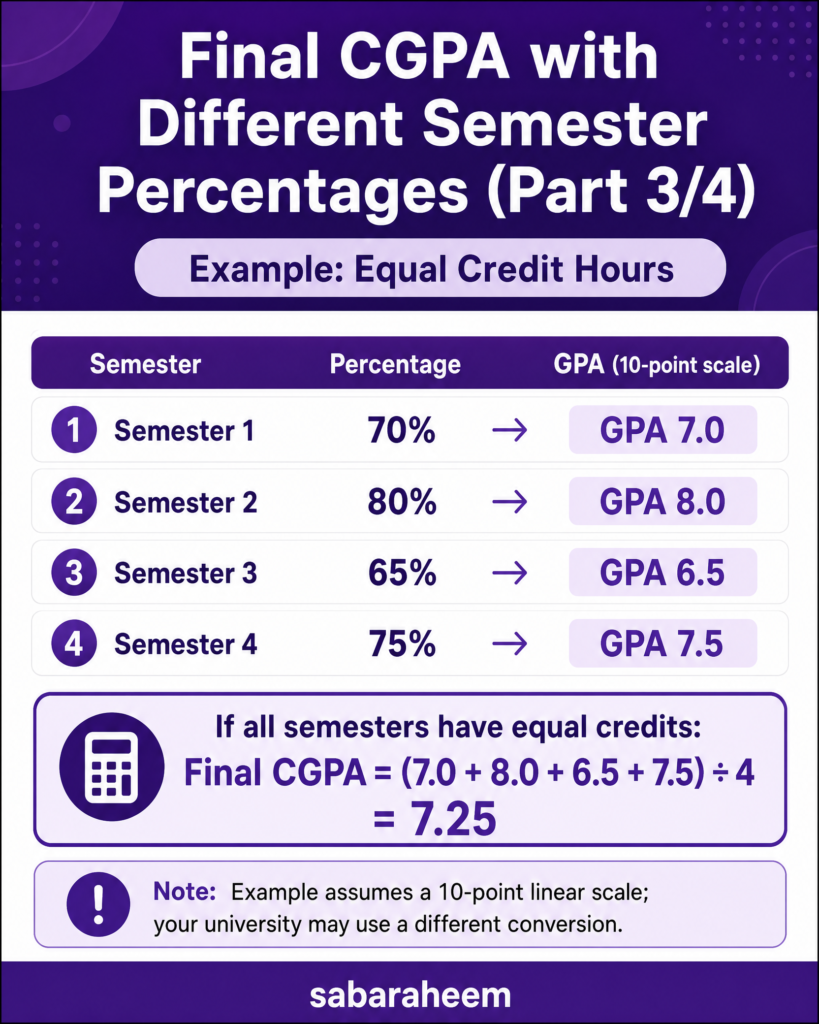
| Simple Average CGPA | CGPA = Sum of sem GPAs ÷ No. of semesters | Quick estimate only — not official, ignores credit differences | (6.52+7.47+6.10) ÷ 3 = 6.69 CGPA (approximate) |
| Projected CGPA | New CGPA = (Old CGPA × Old Credits + New GPA × New Credits) ÷ Total Credits | Estimating what your CGPA will be after next semester | (7.5×150 + 9.0×25) ÷ 175 = 7.71 CGPA |
| US GPA (4.0) from % | Standard letter grade conversion table | US, Canada applications — or WES evaluation estimate | 75% = B+ = 3.3 GPA on 4.0 scale |
Which Formula Should You Use?
The answer depends entirely on your institution. Here is how to find out which formula applies to you:
- Check your university’s official academic regulations document — usually available on the registrar or examinations page of the university website
- Look at your marksheet or grade sheet — many universities print the conversion factor directly on the document
- Check the CGPA that appears on your official transcript against the percentage shown — divide the percentage by the CGPA to find your university’s actual divisor
- If in doubt, contact your university’s examination department — they are required to tell you the official conversion formula
| Important: The most common calculation mistake is using 9.5 when your university uses 10.0 or vice versa. A student with 75% at a university using 9.5 has 7.89 CGPA. The same student at a university using 10.0 has 7.5 CGPA. The difference matters for placements and applications where cutoffs are precise. |
6 Calculation Mistakes to Avoid When Percentages Vary
These are the most common errors students make when their semester percentages are inconsistent:
| Mistake | Wrong Calculation | Correct Approach |
| Using simple average for varying semesters | Add all sem percentages and divide by number of semesters | Weight each semester by its credit hours before averaging |
| Dividing by 10 instead of 9.5 | 75 ÷ 10 = 7.5 CGPA | 75 ÷ 9.5 = 7.89 CGPA (standard Indian formula) |
| Using one semester GPA as CGPA | My sem GPA is 8.5 so my CGPA is 8.5 | CGPA is cumulative — average across all completed semesters |
| Ignoring credit weights | Treating a 1-credit elective the same as a 4-credit core subject | Multiply each grade by its credits before averaging |
| Rounding up aggressively | 7.89 reported as 8.0 on application forms | Report exactly as shown on marksheet — rounding is misrepresentation |
| Including non-credit courses | Including audit or S/U graded subjects in percentage base | Only include credit-bearing graded subjects in CGPA calculation |
For a complete guide to all CGPA calculation errors, read: 10 Common CGPA Calculation Mistakes Students Make.
What People Search About Variable Semester CGPA
These are real search queries students use in 2026:
- What is my final CGPA if my percentage varies each semester?
- How to calculate CGPA when each semester is different
- How to convert percentage to CGPA step by step
- What is my CGPA if I have 75%?
- Percentage to CGPA conversion formula explained
- How to calculate cumulative CGPA with different credits each semester
- What happens to CGPA if one semester is bad?
- How much does a bad semester affect final CGPA?
- Is 75 percent a good CGPA in India?
- CGPA calculation formula for Indian universities 2026
—-
Full Percentage to CGPA and GPA Conversion Table
Use this table for instant reference across any percentage from 50% to 100%:
| Percentage | CGPA (÷9.5) | US GPA (4.0) | UK Class | Letter | Status |
| 95-100% | 10.0 | 4.0 | First Class | A+ | Outstanding |
| 85-94% | 8.95-9.89 | 4.0 | First Class | A | Distinction |
| 80-84% | 8.42-8.84 | 3.7 | First Class | A- | Very Good |
| 75-79% | 7.89-8.31 | 3.3 | First Class | B+ | Good |
| 70-74% | 7.36-7.78 | 3.0 | 2nd Class Upper | B | Above Average |
| 65-69% | 6.84-7.26 | 2.7 | 2nd Class Upper | B- | Average |
| 60-64% | 6.31-6.73 | 2.3 | 2nd Class Lower | C+ | Pass |
| 55-59% | 5.78-6.21 | 2.0 | 2nd Class Lower | C | Pass |
| 50-54% | 5.26-5.68 | 1.7 | Third Class | C- | Minimum Pass |
| Below 50% | Below 5.26 | Below 1.0 | Fail | F | Fail |
For any percentage not listed, get an instant accurate result at percentage2cgpa.site — the free converter uses the standard 9.5 formula and shows your CGPA, US GPA equivalent, and letter grade in one step.
Frequently Asked Questions
What is my final CGPA if my percentage varies each semester?
Your final CGPA is calculated using a credit-weighted average — not a simple average of your semester percentages. Each semester’s percentage is multiplied by its credit hours, the results are summed, and the total is divided by your total credit hours across all semesters. This gives your weighted aggregate percentage, which is then divided by 9.5 (for most Indian universities) to get your CGPA. A student varying between 58% and 88% across 8 semesters can finish with a 7.70 CGPA.
How to convert percentage to CGPA step by step?
Step 1 — find your university’s divisor (usually 9.5 for Indian institutions). Step 2 — take your aggregate percentage. Step 3 — divide by the divisor: CGPA = Percentage / 9.5. Step 4 — verify against your official marksheet. For multiple semesters, first calculate the credit-weighted average of all semester percentages, then apply the divisor. Use the free converter at percentage2cgpa.site for an instant result.
What is my CGPA if I have 75%?
On the standard Indian 9.5 scale: 75 / 9.5 = 7.89 CGPA. On a 10.0 scale: 7.5 CGPA. On the US 4.0 scale: approximately 3.3 GPA (B+ equivalent). On the UK honours system: First Class (70% and above). On the Australian 7-point system: Distinction (75% and above). Which conversion is correct depends on which university or grading system is asking.
Does a bad semester ruin your CGPA permanently?
Not permanently, especially if the bad semester occurs early in your degree. CGPA is a cumulative weighted average — a bad semester loses influence over time as more credit hours are completed. A student with a poor Semester 1 (24 credits) who completes 7 more semesters (174 additional credits) will find that Semester 1 accounts for only about 12 percent of their final CGPA. Consistent improvement in later semesters is the most effective recovery strategy.
Why is credit-weighted CGPA different from a simple average?
Different semesters have different numbers of credit-bearing subjects and different total credit hours. A semester with 26 credits counts more than a semester with 20 credits. A simple average treats all semesters as equal regardless of credits — which produces an inaccurate result. The credit-weighted average reflects the actual proportion of your degree that each semester represents, which is why universities use it for official CGPA calculation.
How is the percentage to CGPA formula different across universities?
Most Indian universities use the 9.5 divisor endorsed by UGC and AICTE. Some use 10.0, particularly older institutions or those following state board guidelines. A few use 9.0. The difference matters: 75% gives 7.89 CGPA on the 9.5 scale, 7.5 CGPA on the 10.0 scale, and 8.33 CGPA on the 9.0 scale. Always verify your university’s specific formula from their academic regulations before calculating or reporting your CGPA.
—-
More Tools and Guides on percentage2cgpa.site
| Anchor Text | URL |
| Free Percentage to CGPA Converter | https://percentage2cgpa.site/ |
| 10 Common CGPA Calculation Mistakes | https://percentage2cgpa.site/blogs/ |
| What Is 70% in CGPA on a 4.0 Scale? | https://percentage2cgpa.site/blogs/ |
| How to Improve Your CGPA — 10 Strategies | https://percentage2cgpa.site/blogs/ |
Anchor Text Suggestions for Internal Linking
Use these when linking to this post from other pages on percentage2cgpa.site:
- what is my final CGPA if percentage varies each semester
- how to calculate CGPA with varying semester percentages
- percentage to CGPA conversion formula explained
- what is my CGPA if I have 75 percent
- how to convert percentage to CGPA step by step
- credit-weighted CGPA calculation guide
- final CGPA with inconsistent semester scores
- 75% to CGPA conversion on 9.5 scale
- semester CGPA varying calculation India
- CGPA formula for 8 semesters with different percentages
Calculate Your Exact CGPA in 2 Seconds
Enter your semester percentages and credit hours at percentage2cgpa.site — get your credit-weighted CGPA, US GPA equivalent, and letter grade instantly. Free, no sign-up required.
Sources and References
UGC Credit Framework for Higher Education India · AICTE Grading Guidelines · CBSE Official Grading Policy · Anna University Academic Regulations 2021 · WES World Education Services GPA Conversion Chart · percentage2cgpa.site standard 9.5 scale formula